The UV index is a scale that measures how strong the sun's skin-burning ultraviolet radiation is: it starts at 0, and the higher the number, the faster sunburn sets in. The World Health Organization (WHO) groups its values into five levels, from low (1–2) to extreme (11 or more), each with its own advice. In short, a UV index of 0–2 is safe for most people without protection, from 3 you need sun protection, and from 8 you need extra care.
The UV index has nothing to do with temperature: a cool spring day can have a higher index than a hot day in early fall, because what matters is how high the sun is.
Key takeaways
- The UV index measures sunburning ultraviolet radiation on a common international scale defined by the WHO, the World Meteorological Organization and other bodies.
- WHO levels: 1–2 low, 3–5 moderate, 6–7 high, 8–10 very high and 11 or more extreme.
- Sun protection is recommended from a UV index of 3; from 8, avoid the midday sun and take extra precautions.
- UV peaks around solar noon, which falls closer to 1 p.m. than noon on daylight saving time; the riskiest hours are roughly 10 a.m. to 4 p.m.
- Fresh snow reflects up to 80% of UV radiation, and UV rises by 10–12% for every 1,000 m (3,300 ft) of altitude, according to the WHO.
What does the UV index mean?
The UV index is a number that expresses the intensity of ultraviolet radiation reaching the ground, weighted by its power to redden human skin. Each point equals 25 milliwatts per square meter of this "erythemal" radiation, so a UV index of 8 is twice as intense as a UV index of 4.
The scale was agreed internationally in the Global Solar UV Index guide, published by the WHO with the World Meteorological Organization, the United Nations Environment Programme and the International Commission on Non-Ionizing Radiation Protection. In the US, the EPA and the National Weather Service publish daily UV forecasts on the same scale, and Australia's Bureau of Meteorology does the same.
UV index scale: what each level means
Each level of the UV index tells you how much protection you need, and the WHO gives each one a color so you can read it at a glance.
| UV index | Level (WHO) | Color | What to do |
|---|---|---|---|
| 0–2 | Low | Green | No special protection needed for most people. Sunglasses on bright days. |
| 3–5 | Moderate | Yellow | Seek shade around midday. Wear sunglasses, a hat and sunscreen if you will be outside for long. |
| 6–7 | High | Orange | Reduce time in the sun in the middle of the day. Cover up, wear a wide-brimmed hat, sunglasses and SPF 30+ sunscreen. |
| 8–10 | Very high | Red | Extra protection: avoid the midday sun, stay in shade when you can, reapply sunscreen every two hours. |
| 11+ | Extreme | Violet | Avoid being outside in the middle of the day. Fair skin can burn in a few minutes. All the measures above are essential. |
UV index and time to burn
There is no single "time to burn" per level, because it depends on your skin type. What holds for everyone is that the time halves as the index doubles: skin that burns after a given time at UV 5 burns in about half that time at UV 10.
What UV index is safe?
A UV index of 0 to 2 is considered safe for most people to be outside without sun protection, while 3 or higher is strong enough to damage unprotected skin. Cancer Council Australia, which runs the SunSmart program, recommends sun protection whenever the UV index is 3 or above.
What UV index is safe without sunscreen?
Below 3, most people can spend short periods outside, even at midday, without sunscreen. People with very fair skin, those taking medicines that increase sun sensitivity and anyone with a history of skin cancer may need protection at lower levels.
What UV index is safe for babies?
Babies under 6 months should be kept out of direct sunlight altogether, whatever the UV index, according to the American Academy of Pediatrics. Use shade, a stroller canopy, light clothing that covers arms and legs and a brimmed hat. For older babies and toddlers, add a broad-spectrum sunscreen of SPF 30 or more on exposed skin when the index is 3 or higher.
What UV index is safe for vitamin D?
You do not need to sunbathe to make vitamin D: Cancer Council Australia says that when the UV index is 3 or above, most people get enough from a few minutes of everyday outdoor activity on most days, and that deliberate unprotected exposure at those levels is not recommended.
Can you tan with a UV index of 4 or 5?
Yes: you can tan, and burn, at a UV index of 3, 4 or 5, even on a cloudy day, and faster at higher levels. But a tan is not protection. The American Academy of Dermatology states that there is no safe tan: any tan is a sign that UV has damaged the skin's DNA, which raises the risk of skin cancer and speeds up skin aging. A "base tan" does not prevent sunburn; self-tanning products are the safer route.
What time is the UV index highest?
The UV index peaks around solar noon, when the sun is highest in the sky. With daylight saving time, solar noon in most of the US and Europe falls nearer 1 p.m. than noon, which is why the riskiest window is roughly 10 a.m. to 4 p.m.
The WHO suggests a simple test that needs no app: if your shadow is shorter than you are, the sun is high and the UV index is strong.
Is there UV in winter, with clouds or on snow?
Yes: UV radiation reaches the ground all year, through clouds, and on snow it can be as intense as on a summer beach. These factors change it most:
- Clouds: according to the WHO, over 90% of UV radiation passes through thin or scattered clouds. A hazy sky does not protect you; only thick cloud cuts the index a lot.
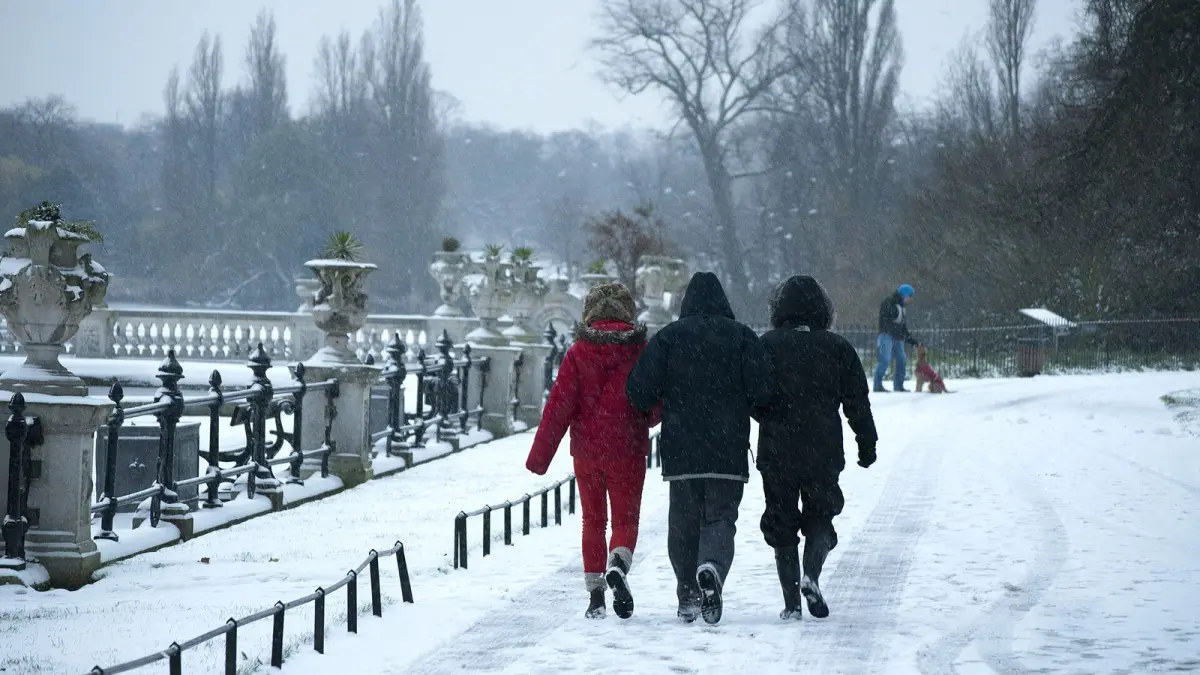
- Snow: fresh snow reflects up to 80% of UV, which hits you from above and below. That is why skiers burn on cold days.
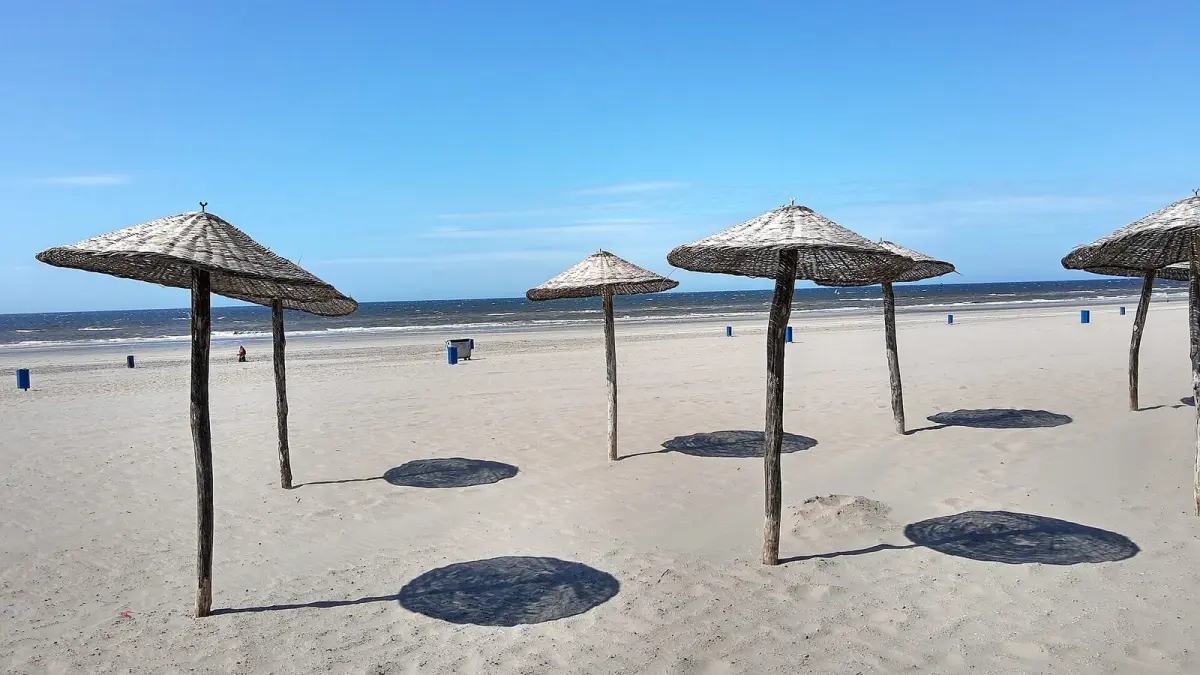
- Sand and water: dry sand reflects about 15% and sea foam about 25%, per the WHO, so an umbrella does not block it all.
- Altitude: thinner air filters less. The WHO estimates UV rises 10–12% for every 1,000 m (3,300 ft).
Where is the UV index highest?
UV levels are highest in the tropics, at high altitude and in the Southern Hemisphere summer. Right now, in November and December, the sun is near its highest over Australia, South America and southern Africa, and cities such as Sydney and Perth regularly reach the extreme category (11+) in summer.
Altitude makes a big difference in Latin America:
- Mexico City, at about 2,240 m (7,350 ft), often reaches the extreme level between March and September. Check the 14 day forecast for Mexico City.
- Bogotá, at about 2,600 m (8,500 ft) and almost on the equator, often exceeds 11, and the sun burns there year round even though the air feels mild. See the weather in Bogotá before a day out.
- The Caribbean sits in the tropics, so the index is high for most of the year; our guide to the best time to visit the Caribbean covers the seasons there.
How to protect yourself from the sun
To protect yourself, combine shade, clothing and sunscreen, and match the effort to the day's UV index:
- Check the UV index before you go out, not the temperature. A cool or cloudy day can still have a high index.
- Seek shade in the middle of the day, especially at UV 6 or above.
- Cover up with a shirt, a wide-brimmed hat and sunglasses that block UV.
- Use broad-spectrum sunscreen of SPF 30 or higher, generously. Reapply every two hours and after swimming or sweating.
- Protect children with extra care, and keep babies under 6 months out of direct sun.
Sunscreen complements shade and clothing; it does not replace them. If you get a blistering burn over a large area, fever, dizziness or confusion, seek medical help, and in an emergency call 911 in the US and Canada, 999 in the UK, 112 in the EU or 000 in Australia. When strong sun comes with high temperatures, review the heat stroke symptoms too.
How to check the UV index today on Clima de Hoy
On Clima de Hoy, each city page shows the current UV index with its WHO level and a protection tip, for example in today's weather in Miami. The 14 day view shows the forecast maximum UV index for each day in its level color, so you can plan a hike or a beach day, for example with the 14 day forecast for Cancún.
If the forecast shows high, thin clouds, the index will hardly drop. Our guide to the feels like temperature explains why direct sun also makes heat feel stronger.
Frequently asked questions
What UV index is dangerous?
According to the WHO, you should protect yourself from a UV index of 3, and from 8 the risk is very high, with fair skin burning quickly. At 11 or more the level is extreme and the advice is to avoid the midday sun. People with very fair skin can burn even at moderate levels.
Can you get sunburned on a cloudy day?
Yes. According to the WHO, more than 90% of UV radiation passes through thin clouds, so a hazy or partly cloudy sky gives little protection. Because you do not feel the heat, you also tend to stay out longer. Only a thick, unbroken cloud layer really lowers the UV index.
Do I need sunscreen in winter?
In the UK, northern Europe and much of the northern US, the winter UV index usually stays between 0 and 2, so a short time outside rarely calls for sunscreen. You do need it on snow, at high altitude, in the tropics and in the Southern Hemisphere, where it is summer from December to February.
Weather in your city
- Weather in Ciudad de México
- Weather in Londres
- Weather in Nueva York
- Weather in Bogotá
- Weather in Madrid
- Weather in Buenos Aires
- Weather in París
- Weather in Barcelona
- Weather in Valencia
- Weather in Sevilla
- Weather in Málaga
- Weather in Bilbao