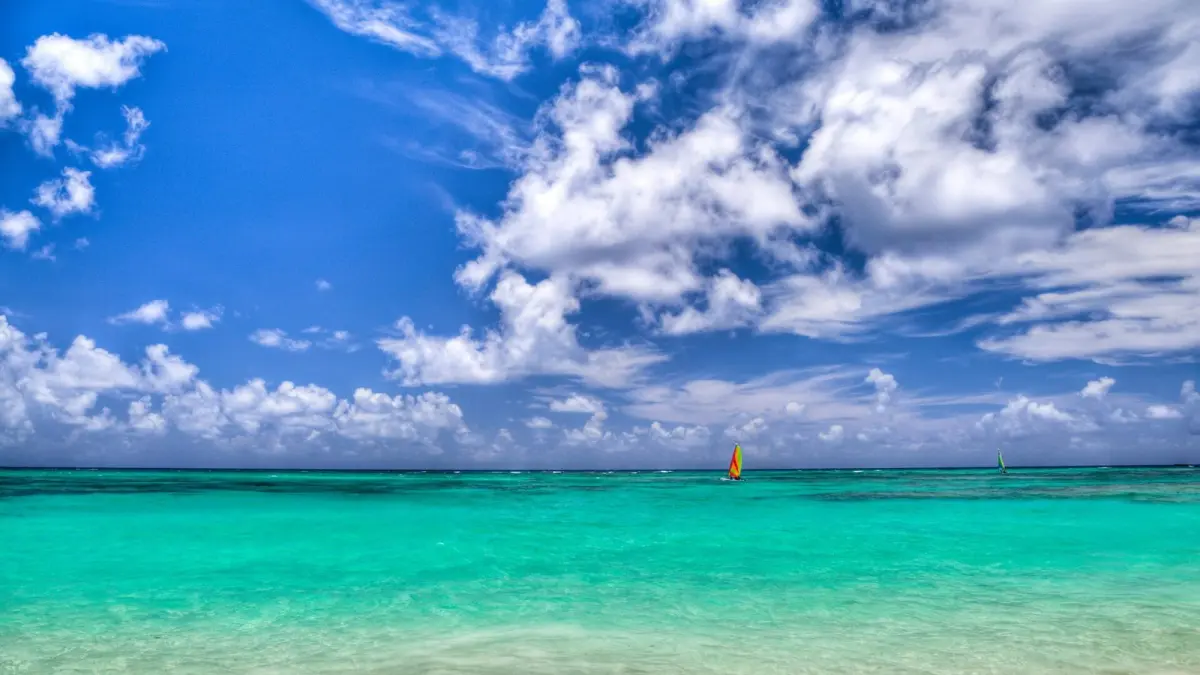
The best time to visit the Caribbean for good weather is the dry season, from December to April: there is little rain, lower humidity, highs around 28 to 30 °C (82 to 86 °F) and no hurricane season. From June to November it is hotter and wetter, and that is when hurricanes form, with the highest risk from mid-August to mid-October. May, early June and November are good shoulder months with lower prices.
Key takeaways
- The Caribbean dry season runs from December to April and is the best time to visit Punta Cana, Cancun, Havana or San Juan.
- The Atlantic hurricane season, which includes the Caribbean, runs from June 1 to November 30; the peak risk is from mid-August to mid-October.
- The sea is about 26 °C (79 °F) in winter and reaches 28 to 29 °C (82 to 84 °F) between August and October.
- In Punta Cana, average highs range from about 28 °C (82 °F) in winter to 32 °C (90 °F) in summer, and lows rarely fall below 20 °C (68 °F).
- Sargassum seaweed usually reaches the beaches between spring and late summer, with large differences from year to year.
When is the best time to visit the Caribbean?
The best time to visit the Caribbean is from December to April, the dry season, with sunny days, a steady trade wind breeze and pleasant nights. It is also high season: prices rise, especially at Christmas, New Year, spring break and Easter.
For good weather with fewer crowds, May and early June usually work well: it is hotter and the first showers arrive, but it is early for hurricanes. November is also a reasonable choice: tropical activity drops sharply, although the official season does not end until November 30.
August, September and October are the hottest, most humid and wettest months, with the highest hurricane risk. Prices are the lowest of the year, and many people travel then without trouble, but you need flexible plans.
Best time to visit the Caribbean on a cruise
For a Caribbean cruise, December to April gives the calmest seas and the most reliable sunshine. In hurricane season, cruise lines change itineraries to steer around storms, so a port of call can be swapped or skipped at short notice.
When is the best time to visit Punta Cana?
The best time to visit Punta Cana is from December to April, when there is less rain and the heat is milder. February and March are usually the driest and most stable months, with highs of about 28 to 29 °C (82 to 84 °F) and the sea around 26 °C (79 °F).
Punta Cana, on the eastern tip of the Dominican Republic, is fully exposed to the trade wind, which takes the edge off the heat even in summer. Rain usually comes as short afternoon showers, unless a tropical wave or storm passes. For families, the dry season months outside school holidays combine the best weather with lower prices. Check the weather in Punta Cana before you pack.
When is the best time to go to Cancun?
The best time to go to Cancun for good weather is from December to April, with February to April the driest stretch. In winter, Cancun sometimes gets "nortes", cold fronts that bring wind, rough sea and one or two cooler days, so January can be a little more changeable than March.
May is hot and still fairly dry. From June the rain increases, and October is the wettest month, with about 280 mm (11 in) on average, according to Mexico's National Meteorological Service (SMN). You can follow the 7 day forecast for Cancun.
What about Havana and San Juan?
Havana has a slightly cooler winter than Punta Cana because northern cold fronts reach it; from December to March some nights drop below 20 °C (68 °F). San Juan, Puerto Rico, has a climate very similar to Punta Cana, warm all year with more frequent showers from May to November.
For both, December to April brings the driest weather. See the weather in Havana or the 14 day forecast for San Juan.
What is the weather like in Punta Cana and Cancun month by month?
It is warm all year in Punta Cana and Cancun: the differences between months are mostly in rain, humidity and hurricane risk. The table shows approximate averages; for Cancun, the values of the SMN station, 1981-2010 normals.
| Month | Punta Cana high/low | Punta Cana rain | Cancun high/low | Cancun rain | Sea |
|---|---|---|---|---|---|
| January | 82/70 °F (28/21 °C) | 2.6 in (67 mm) | 82/68 °F (28/20 °C) | 4.1 in (105 mm) | 79 °F (26 °C) |
| February | 82/70 °F (28/21 °C) | 2.2 in (55 mm) | 86/68 °F (30/20 °C) | 2.0 in (50 mm) | 79 °F (26 °C) |
| March | 84/70 °F (29/21 °C) | 2.1 in (53 mm) | 88/70 °F (31/21 °C) | 1.8 in (46 mm) | 79 °F (26 °C) |
| April | 86/72 °F (30/22 °C) | 2.9 in (73 mm) | 90/73 °F (32/23 °C) | 1.1 in (29 mm) | 79 °F (26 °C) |
| May | 86/73 °F (30/23 °C) | 5.2 in (131 mm) | 93/75 °F (34/24 °C) | 3.5 in (89 mm) | 81 °F (27 °C) |
| June | 88/73 °F (31/23 °C) | 4.4 in (112 mm) | 93/77 °F (34/25 °C) | 5.6 in (141 mm) | 82 °F (28 °C) |
| July | 90/75 °F (32/24 °C) | 3.6 in (92 mm) | 93/77 °F (34/25 °C) | 2.8 in (70 mm) | 82 °F (28 °C) |
| August | 90/75 °F (32/24 °C) | 4.0 in (101 mm) | 95/77 °F (35/25 °C) | 3.5 in (88 mm) | 82 °F (28 °C) |
| September | 90/75 °F (32/24 °C) | 4.3 in (109 mm) | 93/75 °F (34/24 °C) | 7.2 in (184 mm) | 84 °F (29 °C) |
| October | 88/73 °F (31/23 °C) | 5.6 in (142 mm) | 90/73 °F (32/23 °C) | 11.1 in (282 mm) | 84 °F (29 °C) |
| November | 86/72 °F (30/22 °C) | 4.7 in (119 mm) | 86/72 °F (30/22 °C) | 5.0 in (128 mm) | 82 °F (28 °C) |
| December | 84/72 °F (29/22 °C) | 3.5 in (89 mm) | 84/70 °F (29/21 °C) | 3.5 in (90 mm) | 81 °F (27 °C) |
The Cancun station is slightly inland, so in the Hotel Zone, by the sea, summer highs are usually a little lower.
When is the Caribbean hurricane season?
The Caribbean hurricane season runs from June 1 to November 30, the same as the whole Atlantic basin. Activity peaks between mid-August and mid-October, when the sea is warmest; June, July and November are usually much quieter.
Hurricane season does not mean a hurricane will hit during your trip: at any one place a direct hit is uncommon, but a passing system can cancel flights or excursions for a few days. When one does hit, it can be severe: in October 2025, Hurricane Melissa made landfall in Jamaica as a Category 5 with 185 mph (298 km/h) winds. We explain how these storms form and how they are ranked in how do hurricanes form.
Risk also varies by island. Aruba, Bonaire and Curaçao, at about 12° N off the coast of Venezuela, lie south of the main hurricane track and are rarely hit directly, which makes them a common choice for late summer trips.
If you travel between August and October:
- Buy travel insurance that covers weather cancellations, before a storm has a name.
- Follow official warnings: the US National Hurricane Center (NHC), Mexico's SMN and the national weather service of the country you visit.
- Check the forecast every day in the days before your flight.
- Follow your hotel's instructions if a warning is issued: resorts have shelter plans.
What is the sea temperature in the Caribbean?
The Caribbean Sea is about 26 °C (79 °F) from January to April and 28 to 29 °C (82 to 84 °F) between August and October, warm enough for swimming all year. That warm late summer water is exactly the fuel hurricanes need, at least 26.5 °C (80 °F).
In winter the water is still very pleasant, although on windy days it can feel cool when you get out.
When is the best time to go to Cancun to avoid seaweed?
The best time to avoid sargassum seaweed in Cancun and Punta Cana is usually from November to March, before the main arrival season. Sargassum is a brown seaweed that floats in huge mats in the tropical Atlantic and, for a little over a decade, has reached Caribbean beaches in very large amounts.
It usually arrives between spring and late summer, varying a lot by year and beach. East facing coasts, such as Punta Cana and the Riviera Maya, are the most exposed. It is harmless in the water, but on the sand it rots and smells. Quintana Roo, the Mexican state that includes Cancun, publishes a sargassum traffic light, and many hotels set up barriers and clean the beach every morning.
How to use Clima de Hoy before a Caribbean trip
Two weeks before you leave, look at the 14 day forecast for your destination to see the trend; in the last days, the hourly forecast tells you when the afternoon shower is most likely. To see how forecast rain areas move, use the rain forecast map, built from the GFS model.
In hurricane season, a storm's track comes from official warnings, not a weather app.
Frequently asked questions
What is the best month to go to Punta Cana?
February and March are the best months to go to Punta Cana: they are among the driest of the year, with highs of about 28 to 29 °C (82 to 84 °F) and the sea at 26 °C (79 °F). December, January and April are also very good, although Christmas and Easter are more expensive.
What are the Caribbean hurricane season months?
The Caribbean hurricane season runs from June to November, officially June 1 to November 30. The highest risk is from mid-August to mid-October, with the climatological peak around September 10. A direct hit on a given resort is uncommon, but you should travel with insurance and follow official warnings.
When does it rain most in the Caribbean?
In most of the Caribbean it rains most from May to November, peaking in September and October. In Cancun, October is the wettest month, with about 280 mm (11 in) on average according to the SMN. From December to April it rains much less.
Weather in your city
- Weather in Ciudad de México
- Weather in Londres
- Weather in Nueva York
- Weather in Bogotá
- Weather in Madrid
- Weather in Buenos Aires
- Weather in París
- Weather in Barcelona
- Weather in Valencia
- Weather in Sevilla
- Weather in Málaga
- Weather in Bilbao