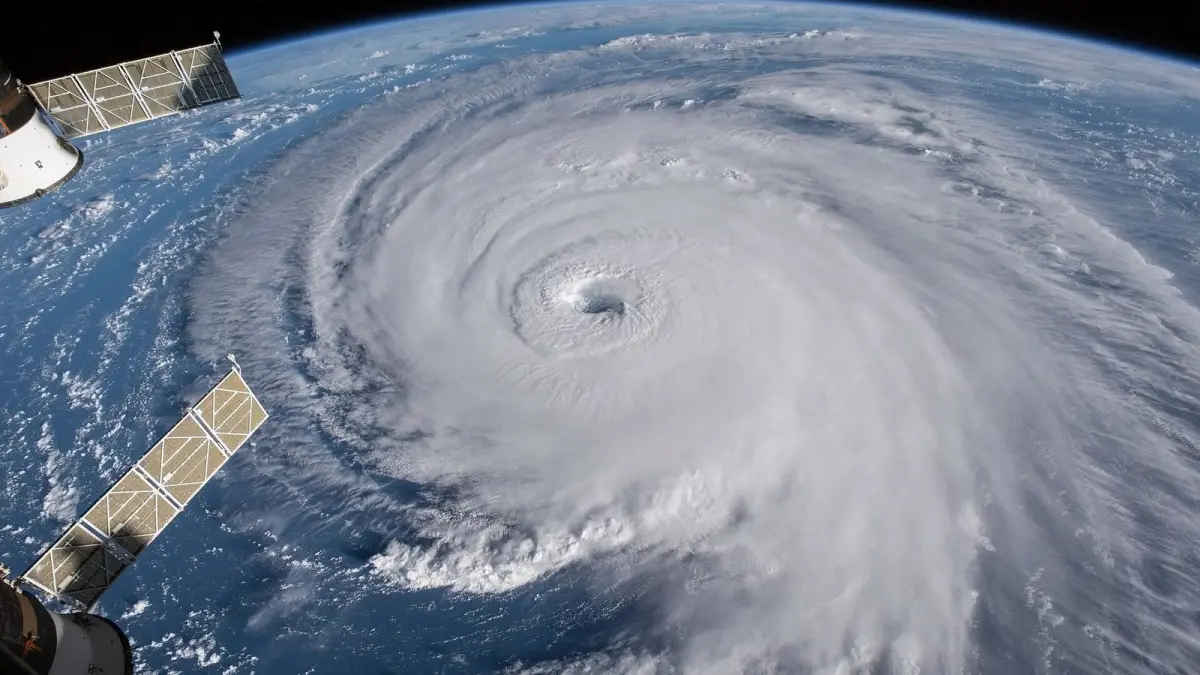
Hurricanes form when a cluster of thunderstorms over a tropical ocean, with water at 26.5 °C (80 °F) or warmer, organizes and starts to spin around a center of low pressure, feeding on the heat and moisture of the sea. Once its sustained winds reach 74 mph (119 km/h), the storm is called a hurricane and is placed in one of the five categories of the Saffir-Simpson scale. Each ocean basin has official season dates and a list of storm names set by the World Meteorological Organization (WMO).
Key takeaways
- A hurricane needs sea water of at least 26.5 °C (80 °F) down to about 50 m (165 ft), moist air and little wind shear.
- It grows through four stages: tropical disturbance, tropical depression, tropical storm (named from 39 mph) and hurricane (from 74 mph).
- The Saffir-Simpson scale runs from Category 1 to 5; a Category 3 or stronger (111 mph or more) is a major hurricane. There is no Category 6.
- The Atlantic hurricane season runs from June 1 to November 30; the eastern Pacific season starts on May 15 and also ends on November 30.
- Hurricane, typhoon and cyclone are the same phenomenon with different names depending on the ocean.
How do hurricanes form, step by step?
A hurricane is born from a group of tropical thunderstorms that finds the right conditions to organize and rotate. Heat alone is not enough: several ingredients have to come together and last for days.
- Very warm ocean: at least 26.5 °C (80 °F) at the surface and through a layer about 50 m (165 ft) deep. That heat is the fuel.
- Moist air in the middle levels of the atmosphere, so the storm clouds can grow without drying out.
- Low wind shear: the wind must not change much in speed or direction with height. Strong shear tilts the storm and tears off its top.
- Distance from the equator: the system needs the Coriolis effect to spin, and it is close to zero near the equator. That is why hurricanes almost never form within about 5° of latitude of it.
- A starting disturbance: in the Atlantic it is usually a tropical wave, a ripple of low pressure that moves west off the coast of Africa.
When everything lines up, warm, humid air rises, its vapor condenses and releases heat, and surface pressure falls. The system feeds itself while it stays over warm water; over land it loses its fuel and weakens, although its rain can cause flooding for days.
How do hurricanes form, explained simply (for kids)
A hurricane is a giant engine that runs on warm sea water. The warm water evaporates, the moist air rises and turns into huge clouds, and the spin of the Earth makes the whole system turn. The calm hole in the middle is the eye.
What are the stages of a tropical cyclone?
A tropical cyclone goes through four stages defined by its sustained wind. The National Hurricane Center (NHC), the WMO regional center for the Atlantic and the northeast Pacific, uses the wind averaged over one minute.
| Stage | Sustained wind | Name? |
|---|---|---|
| Tropical disturbance | No closed circulation | No |
| Tropical depression | Up to 38 mph (62 km/h) | No, it gets a number |
| Tropical storm | 39 to 73 mph (63 to 118 km/h) | Yes |
| Hurricane | 74 mph (119 km/h) or more | Yes, it keeps the same name |
A tropical depression can still drop torrential rain even if its wind is modest.
What are the hurricane categories by wind speed?
The Saffir-Simpson Hurricane Wind Scale ranks hurricanes in five categories by their maximum one-minute sustained wind, and it is the scale used by the NHC. It only measures wind: it does not include rain or storm surge, which often cause more damage and deaths.
| Category | mph | km/h | knots | Expected damage |
|---|---|---|---|---|
| 1 | 74–95 | 119–153 | 64–82 | Damage to roofs, trees and power lines |
| 2 | 96–110 | 154–177 | 83–95 | Extensive damage, power cuts lasting days to weeks |
| 3 | 111–129 | 178–208 | 96–112 | Devastating; first major hurricane category |
| 4 | 130–156 | 209–251 | 113–136 | Catastrophic; areas uninhabitable for weeks |
| 5 | 157 or more | 252 or more | 137 or more | Catastrophic; a high share of homes destroyed |
To picture those speeds, the Beaufort wind scale also starts force 12, "hurricane force", at 64 knots.
Is there a Category 6 hurricane?
No, Category 5 is the top of the official scale, with no upper limit. The NHC has not adopted a Category 6: above 157 mph the damage is already described as catastrophic. The scale is also no longer based on pressure; the NHC dropped the pressure and storm surge ranges around 2009 to 2010.
How do hurricanes form in the Gulf of Mexico?
Hurricanes in the Gulf of Mexico form or strengthen the same way as in the open Atlantic, but the Gulf adds two features: very warm, deep water and a short distance to the coast. In late summer the Gulf surface often passes 29 °C (84 °F), and the Loop Current carries a deep pool of warm water from the Caribbean.
That combination favors rapid intensification, when a storm's winds jump by at least 35 mph (30 knots) in 24 hours, as the NHC defines it. In October 2024, Hurricane Milton went from a tropical storm to a Category 5 in less than two days over the southern Gulf, before making landfall in Florida as a Category 3. ## When is hurricane season 2026?
The 2026 Atlantic hurricane season, which includes the Caribbean and the Gulf of Mexico, runs officially from June 1 to November 30, 2026. The eastern Pacific season started earlier, on May 15, and also ends on November 30. The central Pacific season, around Hawaii, runs from June 1 to November 30.
These are administrative dates: storms can form outside them, but most fall inside. In the Atlantic, activity peaks around September 10, and about two thirds of it falls between August 20 and October 10, when the sea is warmest. If you are planning a trip, our guide to the best time to visit the Caribbean explains the risk month by month.
In 2026 a strong El Niño has been building in the Pacific, and NOAA's outlooks favored a below-normal Atlantic season for that reason: El Niño increases wind shear over the Caribbean. We explain the mechanism in El Niño vs La Niña.
Hurricane season 2026 names
Atlantic storm names come from six lists of 21 names that rotate every six years, alternating male and female names in English, Spanish and French. The 2026 list starts with Arthur, Bertha and Cristobal, and it includes Leah, which replaced Laura after that name was retired in 2021. The letters Q, U, X, Y and Z are not used.
Names of very deadly or costly storms are retired. If the 21 names run out, a supplemental list is used, which since 2021 replaces the Greek alphabet used in 2005 and 2020.
Hurricane vs typhoon vs cyclone: what is the difference?
A hurricane, a typhoon and a cyclone are the same weather system, a tropical cyclone, named differently depending on the ocean where it forms:
- Hurricane: North Atlantic, Caribbean, Gulf of Mexico, and the northeast and central Pacific.
- Typhoon: northwest Pacific (Japan, China, the Philippines, Korea).
- Cyclone: Indian Ocean and South Pacific (India, Bangladesh, Australia, Madagascar).
Hurricane vs typhoon: which is stronger?
Neither is stronger by definition, but the northwest Pacific produces the most intense storms on average because it has the largest area of warm water. Typhoon Tip holds the record for the lowest central pressure ever measured, 870 hPa, on October 12, 1979. Rotation depends on the hemisphere, not the name: counterclockwise north of the equator, clockwise south of it.
What should you do if a hurricane is coming?
The most useful thing you can do is follow official warnings and act early. In the US, a hurricane watch means hurricane conditions are possible within 48 hours, and a hurricane warning means they are expected within 36 hours. Our guide to weather warning colors explains how watches, warnings and advisories differ.
- Know your evacuation zone and leave when local officials tell you to. Storm surge is the deadliest hazard on the coast.
- Prepare a kit with water, food, medicines, documents, a flashlight and a power bank.
- Never drive through flooded roads: moving water can sweep a car away.
- Stay inside during the eye: the calm is temporary and the wind returns from the opposite side.
In an emergency, call 911 in the US.
How can you follow a hurricane with Clima de Hoy?
Clima de Hoy shows the local forecast of wind, gusts and rain hour by hour in exposed places. Check, for example, the hourly forecast for Miami, the 7 day forecast for Cancun or the weather in San Juan, Puerto Rico. The rain forecast map shows where the GFS model expects rain bands and strong wind to move over the coming hours.
Our forecasts come from numerical models and do not replace the warnings of the National Hurricane Center or your national weather service.
Frequently asked questions
How warm does the ocean need to be for a hurricane to form?
The sea must be at least 26.5 °C (80 °F), not just at the surface but through a layer about 50 m (165 ft) deep. Below that value a tropical cyclone does not get enough energy and tends to weaken. That is why hurricanes form in summer and fall over tropical seas.
When does hurricane season 2026 start and end?
The 2026 Atlantic hurricane season runs from June 1 to November 30, and the eastern Pacific season from May 15 to November 30. These are the same official dates every year.
Who names hurricanes?
Hurricane names are set by the World Meteorological Organization through its regional committees. The Atlantic has six lists of 21 names that repeat every six years, and the names of very destructive storms are retired.
What is the strongest hurricane category?
Category 5 is the highest on the Saffir-Simpson scale, for sustained winds of 157 mph (252 km/h) or more. There is no official Category 6. In October 2025, Hurricane Melissa hit Jamaica as a Category 5 with 185 mph (298 km/h) winds, tying the record for the strongest Atlantic landfall.
Weather in your city
- Weather in Ciudad de México
- Weather in Londres
- Weather in Nueva York
- Weather in Bogotá
- Weather in Madrid
- Weather in Buenos Aires
- Weather in París
- Weather in Barcelona
- Weather in Valencia
- Weather in Sevilla
- Weather in Málaga
- Weather in Bilbao