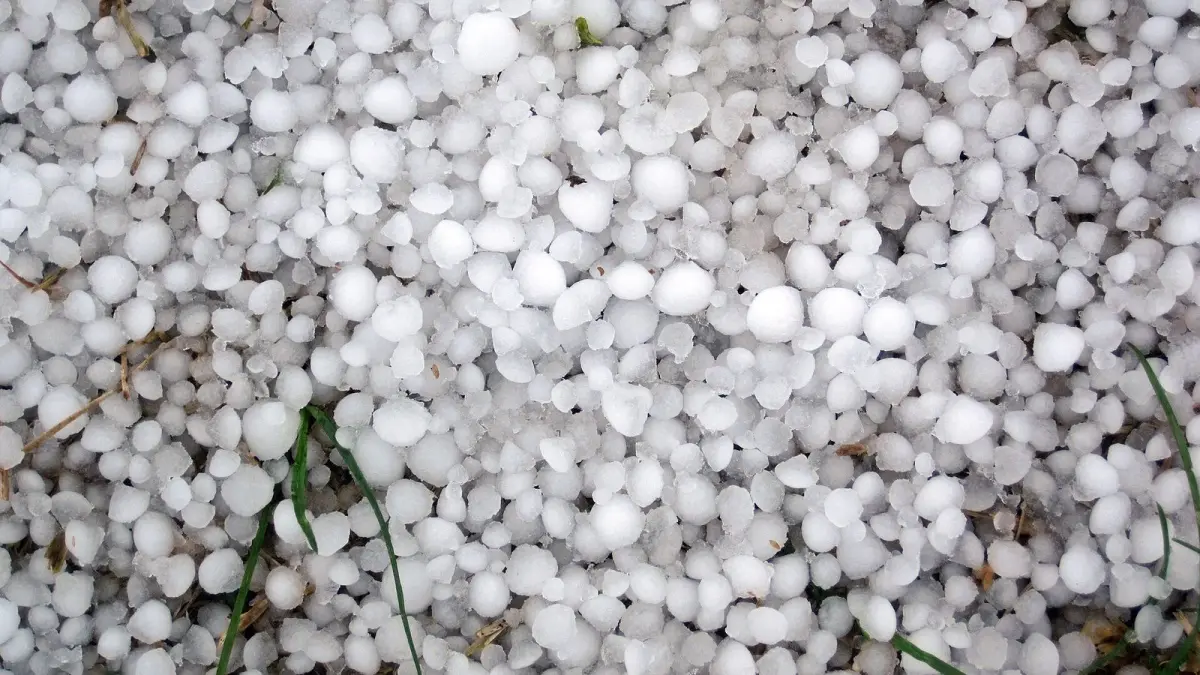
Hail forms inside thunderstorm clouds when strong updrafts carry ice particles high into the cloud, where they grow layer by layer as supercooled water droplets freeze onto them. The hailstone falls when it becomes too heavy for the updraft to hold up, and it is called hail once it reaches 5 mm (0.2 in) across or more.
That is why large hail comes from the most violent thunderstorms and is most common in late spring and summer, when hot ground feeds powerful updrafts.
Key takeaways
- Hail grows inside cumulonimbus clouds, where updrafts keep ice embryos aloft while supercooled water freezes onto them in layers.
- Hail is ice 5 mm (0.2 in) in diameter or larger; smaller, soft white pellets are graupel.
- The US National Weather Service classes hail of 1 inch (25 mm), quarter size, or larger as severe; Australia's Bureau of Meteorology uses 2 cm.
- The largest hailstone on record fell in Vivian, South Dakota, on 23 July 2010: 8 in (20.3 cm) across and 1 lb 15 oz (0.88 kg).
- NOAA's National Severe Storms Laboratory says hailstones larger than 4 in (10 cm) can fall at over 100 mph (160 km/h).
How does hail form in a thunderstorm?
Hail forms in cumulonimbus clouds, thunderstorm clouds that can tower more than 10 km (6 mi) high, in zones where very strong updrafts meet plenty of liquid water at temperatures below freezing. That supercooled water freezes instantly when it touches an ice nucleus.
The process has four stages:
- Embryo: a frozen droplet or a small graupel pellet acts as the seed.
- Growth: the updraft lifts it through supercooled water, which freezes onto it.
- Cycles: it may rise and fall several times, or follow one long path through the updraft, adding layers.
- Fall: when its weight beats the updraft, it falls to the ground.
What is hail made of?
Hail is made of ice, built up in layers around a small frozen core. Cut a large hailstone in half and you will see alternating clear and milky rings. Clear layers form when water freezes slowly and lets air bubbles escape; milky layers form when it freezes so fast that it traps air.
The same updrafts that grow hail also separate the electric charges that produce lightning, which is why hailstorms usually come with thunder. Our guide on what to do in a thunderstorm covers lightning safety.
How does hail form in hot weather?
Hail forms in hot weather because large hail needs very strong updrafts, and those updrafts come from the contrast between very warm air near the ground and cold air aloft. In winter the atmosphere has less energy and clouds are shallower, so ice cannot grow as large.
Although hail starts at subfreezing temperatures high in the cloud, large stones fall so fast that they do not have time to melt on the way down through warm air. Small hail often melts completely and arrives as rain; big stones cross the warm layer almost intact. That is how a summer afternoon at 30 °C (86 °F) can end with ice on the ground.
What is the difference between hail, graupel, sleet and snow?
Hail is hard ice from a thunderstorm, 5 mm or larger; graupel is a soft, white, crumbly pellet smaller than 5 mm; sleet means ice pellets in the US but a mix of rain and snow in the UK; and snow is made of ice crystals that grow directly from water vapor.
| Type | What it is | Size | When it falls |
|---|---|---|---|
| Hail | Hard ice, often in layers | 5 mm (0.2 in) or more | Thunderstorms, mostly spring and summer |
| Graupel | Soft white pellets of rimed snow | Under 5 mm | Cold showers, often in winter |
| Sleet (US) | Ice pellets: raindrops that freeze before landing | Small | Winter storms |
| Sleet (UK) | Rain and snow falling together | Not applicable | Cold, wet weather |
| Snow | Ice crystals and snowflakes | Variable | Cold weather |
Graupel is what many people call "hail" in winter: small white balls that bounce on the ground, squash between your fingers and do no damage.
Hail size chart: how big can hail get?
The NWS hail size chart compares hailstones with everyday objects, from pea size at 0.25 in (6 mm) to softball size at 4.5 in (114 mm).
| Size | Diameter | Typical damage |
|---|---|---|
| Pea | 0.25 in (6 mm) | Damage to leaves and flowers |
| Penny | 0.75 in (19 mm) | Crop damage |
| Quarter | 1 in (25 mm) | NWS severe threshold; dents in cars begin |
| Golf ball | 1.75 in (44 mm) | Broken windows, roof damage |
| Hen egg | 2 in (51 mm) | Serious damage to cars and roofs |
| Tennis ball | 2.5 in (64 mm) | Smashed windshields, injuries |
| Baseball | 2.75 in (70 mm) | Roofs punctured, risk of serious injury |
| Grapefruit | 4 in (102 mm) | Severe damage, danger to life |
| Softball | 4.5 in (114 mm) | Severe damage, danger to life |
The NWS raised its severe thunderstorm threshold from 0.75 in (penny) to 1 in (quarter) in 2010. Australia's Bureau of Meteorology issues severe thunderstorm warnings for hail of 2 cm or more and adds "giant hail" when stones of 5 cm or more are expected. In the UK and Ireland, the TORRO hailstorm intensity scale rates storms from H0 to H10, taking into account size, number of stones and damage. In Spain, AEMET treats hail over 1 cm as a strong storm (yellow warning) and over 2 cm as a very strong one (orange warning).
How fast does hail fall?
Hail falls faster the bigger it is. According to NOAA's National Severe Storms Laboratory, hail under 1 in falls at roughly 9 to 25 mph (14 to 40 km/h), stones of 2 to 4 in at 44 to 72 mph (71 to 116 km/h), and hailstones over 4 in can exceed 100 mph (160 km/h).
What is the largest hailstone ever recorded?
The largest hailstone ever recorded by diameter fell in Vivian, South Dakota, on 23 July 2010: it measured 8 in (20.3 cm) across and weighed 1 lb 15 oz (0.88 kg). The heaviest hailstones on record, according to the World Meteorological Organization, weighed up to 1.02 kg (2.25 lb) and fell in the Gopalganj area of Bangladesh on 14 April 1986, in a storm reported to have killed 92 people.
| Record | Size | Where and when |
|---|---|---|
| World and US, largest diameter | 8 in (20.3 cm), 0.88 kg | Vivian, South Dakota, 23 July 2010 |
| World, heaviest | 1.02 kg (2.25 lb) | Gopalganj, Bangladesh, 14 April 1986 |
| Europe, largest | 19 cm (7.5 in) | Azzano Decimo, Italy, 24 July 2023 |
| Spain, largest documented | About 10 cm (4 in) | La Bisbal d'Empordà, Catalonia, 30 August 2022 |
The European record was confirmed by the European Severe Storms Laboratory (ESSL), only days after a 16 cm stone had set the previous record elsewhere in northern Italy. The Spanish storm in La Bisbal d'Empordà, measured by the Catalan weather service Meteocat, lasted only minutes but killed a 20-month-old girl and injured around fifty people.
How do you protect yourself and your car from hail?
The best protection against hail is to act before it starts: when a severe thunderstorm warning mentions large hail, get your car under cover and people indoors.
Protecting your car
- Park in a garage or covered parking lot when hail is forecast.
- Without a garage, a padded hail cover reduces dents; thick blankets tied down work in an emergency.
- If hail catches you driving, slow down, turn on your lights and look for a gas station canopy or a parking garage. Do not stop under a highway overpass: you block traffic and can cause a crash.
- Inside the car, keep away from the windows and cover your face if the glass might break.
- Check whether your insurance policy covers hail.
Protecting people and crops
- Stay indoors, away from skylights and windows; if caught outside, shield your head with a bag or jacket as you run for shelter.
- Hail nets over orchards and vineyards are the most effective protection for crops in high-risk areas.
- Hail cannons and other methods claimed to break up hailstorms have no scientifically proven effect.
How to know if hail is likely with Clima de Hoy
No forecast can say days ahead which street will get hail, but you can see which days and hours favor thunderstorms. Check the hourly forecast for Zaragoza, in the Ebro valley, one of the most hail-prone parts of Spain, or the hourly forecast for Madrid: in hours with storms forecast, watch the chance of rain and the official warnings.
The rain forecast map shows where showers are expected to move over the next hours. Once a storm has formed, a live radar is the key tool: our guide on how to read weather radar explains which colors usually signal hail. To understand warning levels, see what yellow, amber and red warnings mean.
Frequently asked questions
What is hail?
Hail is solid precipitation made of balls or lumps of ice 5 mm (0.2 in) in diameter or larger. It forms in thunderstorm clouds when updrafts grow ice nuclei with supercooled water. It is most common in late spring and summer.
Why does hail fall in summer?
Hail falls mostly in summer because large hail needs very strong updrafts, which form when the ground is hot and the air aloft is cold. Large stones fall fast enough to reach the ground before melting.
What size hail is considered severe?
The US National Weather Service considers hail of 1 in (25 mm), the size of a quarter, or larger to be severe. Australia's Bureau of Meteorology uses a threshold of 2 cm (0.8 in), and each national weather service sets its own criteria for warnings.
What should you do if hail starts while you are driving?
Slow down, turn on your headlights and look for covered shelter such as a gas station or a parking garage. Do not stop under a highway overpass or on the shoulder in poor visibility. If you cannot leave the road, stop somewhere safe and shield your face from the glass.
Weather in your city
- Weather in Ciudad de México
- Weather in Londres
- Weather in Nueva York
- Weather in Bogotá
- Weather in Madrid
- Weather in Buenos Aires
- Weather in París
- Weather in Barcelona
- Weather in Valencia
- Weather in Sevilla
- Weather in Málaga
- Weather in Bilbao