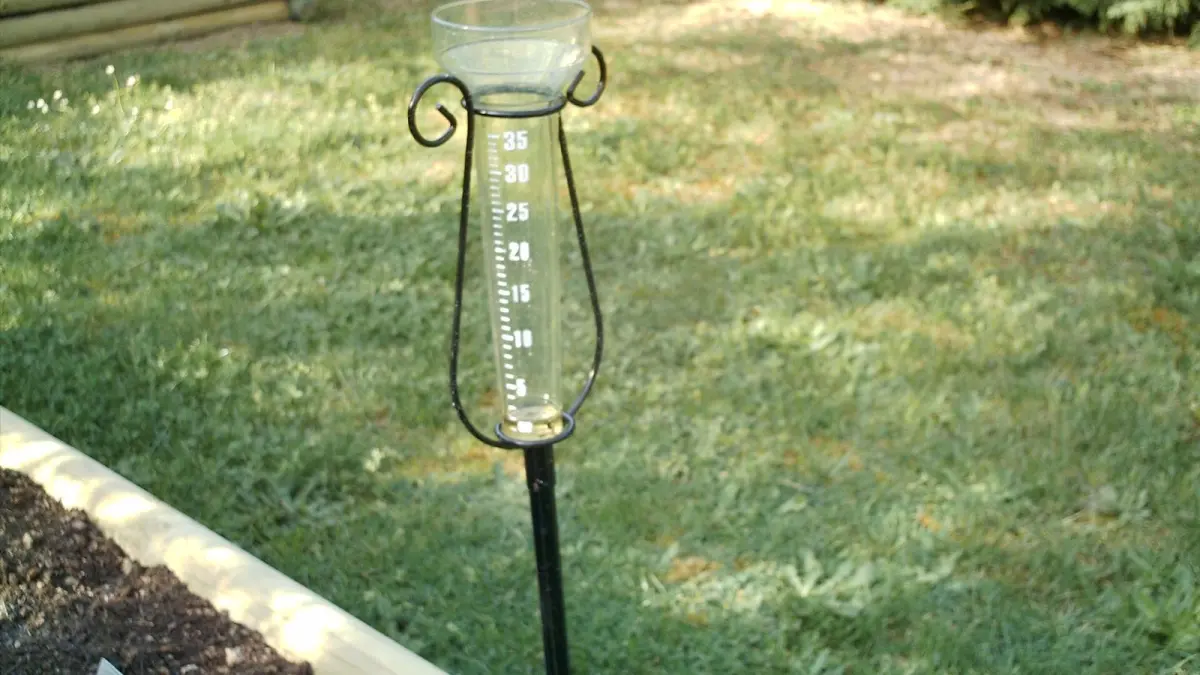
Rainfall is measured with a rain gauge, a container with an opening of known size that collects the rain so its depth can be read in millimeters or inches. One millimeter of rain is a layer of water 1 mm deep over flat ground, the same as 1 liter per square meter, and one inch equals 25.4 mm.
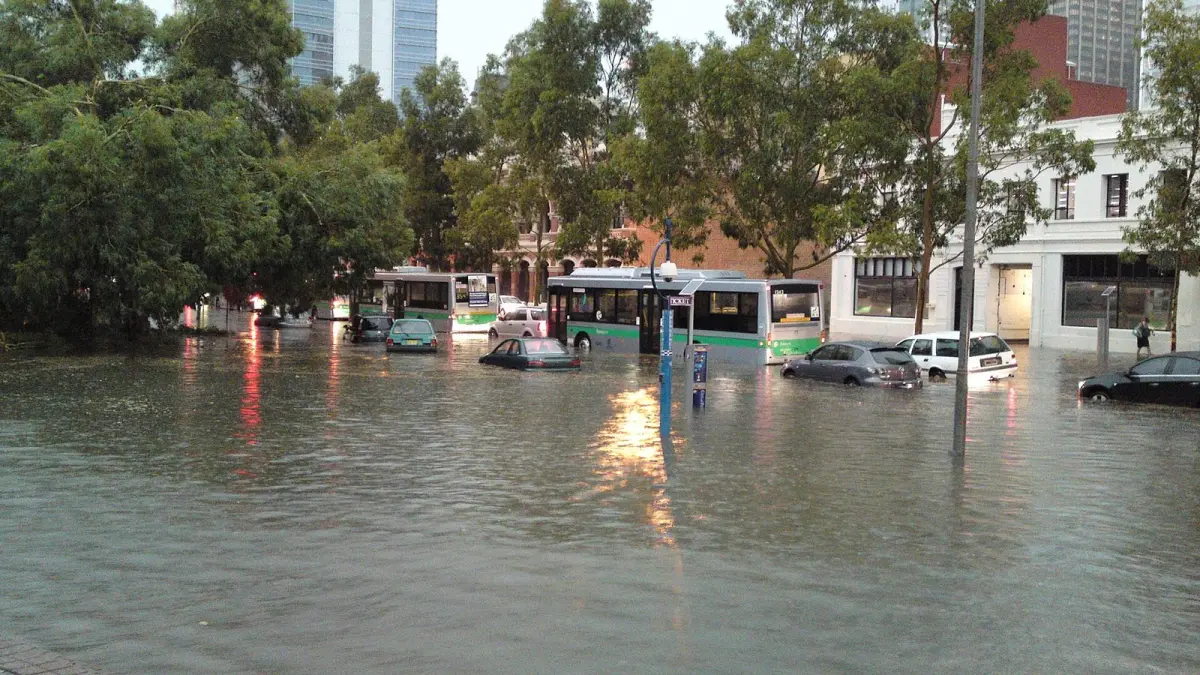
The number on its own says little. An inch of rain spread over a quiet day is very different from an inch in half an hour of thunderstorm: what makes rain dangerous is its intensity, the amount that falls per hour.
Key takeaways
- Rainfall is measured as a depth: 1 mm of rain equals 1 liter of water on each square meter, and 1 inch equals 25.4 mm.
- The standard US National Weather Service gauge has an 8-inch (20 cm) opening and is read to the nearest 0.01 in; the Met Office uses a 5-inch (12.7 cm) gauge.
- The American Meteorological Society defines heavy rain as more than 0.30 in (7.6 mm) per hour.
- One inch of rain on one acre is about 27,154 US gallons of water, according to the USGS.
- The world record for 24 hours, recognized by the WMO, is 1,825 mm (71.8 in) at Foc-Foc, Réunion, in January 1966.
What does mm of rain mean?
Millimeters of rain mean the depth of water that would cover flat ground if none of it soaked in, ran off or evaporated. So 10 mm of rain is a layer of water 1 cm deep, and 25 mm is almost exactly 1 inch.
Millimeters and liters per square meter are the same thing, which is why forecasts in Spain and Latin America often say "litros por metro cuadrado". The math is simple: a liter is a cubic decimeter, and spreading it over a square meter (100 square decimeters) gives a layer one hundredth of a decimeter, 1 mm, deep.
| Millimeters | Inches | What it looks like in a day |
|---|---|---|
| 1 mm | 0.04 in | Drizzle; wets the ground but does not water the garden |
| 5 mm | 0.2 in | Light rain; small puddles |
| 10 mm | 0.39 in | A properly wet day |
| 25 mm | 0.98 in | A very wet day; water pools on poorly drained streets |
| 50 mm | 1.97 in | Heavy rain; local flooding becomes possible |
| 100 mm | 3.94 in | Exceptional rain; flooding is likely in many places |
To convert, divide millimeters by 25.4 to get inches, or multiply inches by 25.4 to get millimeters.
How is rainfall measured using a rain gauge?
A rain gauge measures rainfall by collecting the rain that falls into an opening of known size and recording its depth. Weather services use two main types.
The standard manual rain gauge
The NWS standard rain gauge has an 8-inch (20 cm) funnel that feeds an inner measuring tube with one tenth of the funnel's area. One inch of rain therefore fills the tube to a depth of 10 inches, which lets the observer read rainfall to the nearest hundredth of an inch with a graduated stick. The tube holds 2 inches of rain; any more spills into the outer can and is measured afterwards.
In the UK, the Met Office still uses the design standardized in the 19th century: a 5-inch (12.7 cm) copper funnel with its rim 1 foot (30 cm) above the ground, emptied into a graduated glass measure.
The tipping bucket rain gauge
A tipping bucket gauge funnels rain into two tiny buckets on a seesaw. Each time one fills, it tips and empties, and each tip represents a fixed amount, often 0.2 mm or 0.01 in. Counting the tips over time gives both the total and the intensity minute by minute, which is why automatic weather stations use them. They tend to underestimate rainfall in very intense downpours, when some water is lost while the bucket tips.
Where should a rain gauge go?
A rain gauge should stand in an open spot, well away from walls, trees and roofs that block or deflect rain. Strong wind makes any gauge catch less than actually falls, an error that is larger for snow. In the US, the volunteers of the CoCoRaHS network, which began in Colorado in 1998, report daily rainfall from their gardens with a standard 4-inch (10 cm) gauge.
How much is 1 inch of rain?
One inch of rain is a lot of water: it is a layer 25.4 mm deep over every surface it falls on. In practical terms:
- On an acre: about 27,154 US gallons, weighing about 113 tons, according to the USGS.
- On a 1,000 sq ft roof: about 623 gallons (2,360 liters) that the gutters have to carry away.
- On a 100 m² roof in metric terms: 50 mm of rain sends 5,000 liters through the drains.
- As snow: a common rule of thumb is that 1 inch of rain equals about 10 inches of fresh snow, though wet snow holds more water and powder much less.
When it snows, weather stations melt what the gauge collects and report it as liquid water, so a winter rainfall total includes snow.
What is heavy rain in inches and mm per hour?
The American Meteorological Society defines heavy rain as more than 0.30 in (7.6 mm) per hour, moderate rain as 0.11 to 0.30 in per hour and light rain as up to 0.10 in (2.5 mm) per hour. The NWS uses the same bands when it reports rain intensity.
Spain's AEMET uses wider categories that are useful if you travel there, especially to the Mediterranean coast in autumn:
| Intensity (AEMET) | mm per hour | Inches per hour | What you notice |
|---|---|---|---|
| Light | Up to 2 | Up to 0.08 | Fine rain, few puddles |
| Moderate | 2 to 15 | 0.08 to 0.6 | Steady rain, standing water |
| Heavy | 15 to 30 | 0.6 to 1.2 | Downpour; drains start to overflow |
| Very heavy | 30 to 60 | 1.2 to 2.4 | Streets turn into streams, poor visibility while driving |
| Torrential | Over 60 | Over 2.4 | Flash floods, dry riverbeds overflowing |
Totals over hours matter too. Even modest hourly rates can cause flooding if they last all day, and warnings are usually based on both the hourly rate and the total over 12 or 24 hours.
What are the world's rainfall records?
The world record for rain in 24 hours is 1,825 mm (71.8 in), measured at Foc-Foc on the island of Réunion in the Indian Ocean on 7–8 January 1966, during Tropical Cyclone Denise. The record is recognized by the World Meteorological Organization (WMO).
| Record | Amount | Where and when |
|---|---|---|
| World, 24 hours | 1,825 mm (71.8 in) | Foc-Foc, Réunion, 7–8 January 1966 |
| United States, 24 hours | 49.69 in (1,262 mm) | Waipā Garden, Kauai, Hawaii, 14–15 April 2018 |
| Spain, 1 hour | About 185 mm (7.3 in) | Turís, Valencia, 29 October 2024 |
| Same storm, whole day | About 772 mm (30.4 in) | Turís, Valencia, 29 October 2024 |
The Turís figures come from the catastrophic floods of October 2024 around Valencia, caused by a cut-off low that we explain in what a DANA is. In a single day, Turís received more than one and a half times the yearly average rainfall of the city of Valencia, about 458 mm (18 in) in the 1991–2020 period.
How accurate are radar and forecast rainfall amounts?
Radar estimates rainfall intensity from the strength of its echoes, while models forecast it for grid cells several kilometers wide, so both give estimates rather than measurements. Rain gauges remain the reference used to calibrate radar, as we explain in how to read weather radar.
In thunderstorms, one neighborhood can get double the rain of the next, so a forecast of 10 mm means "around 10 mm in this area", not an exact amount for your street.
How to check expected rainfall on Clima de Hoy
On Clima de Hoy you can see the forecast rainfall in millimeters hour by hour for each city. Open the hourly forecast for Valencia or the hourly forecast for Miami: if an hour shows more than 7.6 mm (0.3 in), that is heavy rain, and if several tens of millimeters add up in a few hours, check the warnings of the national weather service.
Read the amount together with the chance of rain, explained in what a 40% chance of rain means. To see where the forecast rain is moving over the next hours, use the rain forecast map.
Frequently asked questions
Is 1 mm of rain the same as 1 liter per square meter?
Yes. One liter of water spread over one square meter forms a layer exactly 1 mm deep, so the two units are equivalent. A forecast of 25 mm and a forecast of 25 liters per square meter describe the same amount of rain.
How much is 1 inch of rain in mm?
One inch of rain is 25.4 mm. Half an inch is about 13 mm and a tenth of an inch about 2.5 mm, which is the upper limit of light rain in an hour under the American Meteorological Society definition.
How is rainfall measured in the UK?
The Met Office measures rainfall with a standard 5-inch copper gauge whose rim sits 1 foot above the ground, read manually, and with automatic tipping bucket gauges at its weather stations. UK rainfall is reported in millimeters.
How much rain is a lot in one day?
More than 25 mm (1 in) in a day is a very wet day in most places, and more than 100 mm (4 in) in a day is exceptional in most of Europe and North America. Intensity matters most: more than 7.6 mm (0.3 in) in an hour is heavy rain.
Weather in your city
- Weather in Ciudad de México
- Weather in Londres
- Weather in Nueva York
- Weather in Bogotá
- Weather in Madrid
- Weather in Buenos Aires
- Weather in París
- Weather in Barcelona
- Weather in Valencia
- Weather in Sevilla
- Weather in Málaga
- Weather in Bilbao