Climate change in Spain shows up above all as heat: according to Spain's State Meteorological Agency (AEMET), the country's average temperature has risen by 1.75 °C (3.2 °F) since 1961, summers last several weeks longer than in the early 1980s and heat records far outnumber cold ones. The summer of 2026 was the hottest in AEMET's official series. The seas around Spain are warmer too, while total yearly rainfall shows no clear trend, although the way it falls is changing.
Key takeaways
- Spain's average yearly temperature has risen by 1.75 °C (3.2 °F) since 1961, according to AEMET's 2025 state of the climate report.
- Summer 2026 was the hottest since AEMET's official series began in 1961, with a mainland average of 24.5 °C (76.1 °F), 2.4 °C above the 1991-2020 normal.
- Summer in Spain now lasts about five weeks longer than in the early 1980s, according to a 2019 AEMET study.
- Europe is warming about twice as fast as the global average, according to the Copernicus service.
- Total yearly rainfall in Spain has no significant trend since 1961, but droughts and intense downpours alternate more sharply.
Is Spain getting hotter?
Yes, Spain is getting hotter in every season, with longer and more intense summers and warmer seas. AEMET sums it up each year in its report on the state of Spain's climate.
| Indicator | Figure | Source |
|---|---|---|
| Rise in average temperature | +1.75 °C (3.2 °F) since 1961 | AEMET, 2025 report |
| Summer 2026 | 24.5 °C (76.1 °F) on the mainland, +2.4 °C above normal; hottest on record | AEMET |
| Year 2025 | 15.1 °C (59.2 °F) average, 1.1 °C above normal (1991-2020) | AEMET |
| Warmest years | 2022 and 2023, followed by 2024 and 2025 tied | AEMET, 2025 report |
| Heat vs cold daily records (last decade) | 221 heat records against 7 cold ones | AEMET |
| Length of summer | About five weeks longer than in the early 1980s | AEMET, 2019 study |
| Sea temperature in 2025 | 0.8 °C above normal, the second highest after 2023 | AEMET |
AEMET's reconstruction of older data, going back to 1869, also ranks summer 2026 as the hottest. All ten of the warmest summers in the series have come in the 21st century.
Spain heat waves: longer and earlier
Spanish summers are stretching at both ends: the heat arrives earlier in spring and lingers into September and October. AEMET's 2019 study put the lengthening at about nine days per decade. In summer 2026, three heat waves hit the mainland and the Balearic Islands, from June 20 to 27, July 2 to 24 and July 28 to August 20, and another heat wave followed in early September.
Tropical nights, when the temperature stays at 20 °C (68 °F) or above, are becoming more common, especially on the Mediterranean coast, in the south and in the Canary Islands. They hit sleep and health hardest, because the body cannot recover from the heat of the day. Spain's Carlos III Health Institute estimates the deaths attributable to heat each summer through its daily mortality monitoring system.
What is the difference between weather and climate?
Weather is what happens in the atmosphere at a given time and place, and climate is the average of that weather over at least 30 years. The World Meteorological Organization (WMO) uses 30-year periods called climate normals; the current reference is 1991-2020.
That is why a cold winter or a week of snow does not disprove climate change, just as one day at 44 °C (111 °F) does not prove it on its own. What counts is the trend over decades: how many days of extreme heat there are each year, how long summer lasts, how warm the sea is.
What causes climate change in Spain?
The main cause of climate change in Spain, as everywhere, is the rise in greenhouse gases from human activity, above all the carbon dioxide (CO₂) released by burning coal, oil and gas. The UN's Intergovernmental Panel on Climate Change (IPCC) concluded in its sixth report (2021) that it is "unequivocal" that human influence has warmed the atmosphere, ocean and land.
The main sources are fossil fuels for power, transport and industry, methane from livestock, landfills and gas leaks, deforestation and some industrial processes such as cement making. Natural causes, such as changes in solar activity or volcanic eruptions, do not explain the warming of recent decades.
According to the Copernicus Climate Change Service, 2024 was the warmest year on record worldwide, about 1.6 °C above pre-industrial levels and the first calendar year above the 1.5 °C limit of the Paris Agreement. 2025 was the third warmest, at 1.47 °C. Passing 1.5 °C in one or two years does not mean the agreement has been broken, since it refers to long-term averages.
Spain drought and wildfires: what are the effects?
The biggest effects of climate change in Spain after heat are drought and wildfires, because a hotter atmosphere dries soils and vegetation faster even when rain does not fall less. Across Spain as a whole there is no significant trend in total yearly rainfall since 1961, according to AEMET, but evaporation rises with the heat and long dry spells alternate with torrential rain.
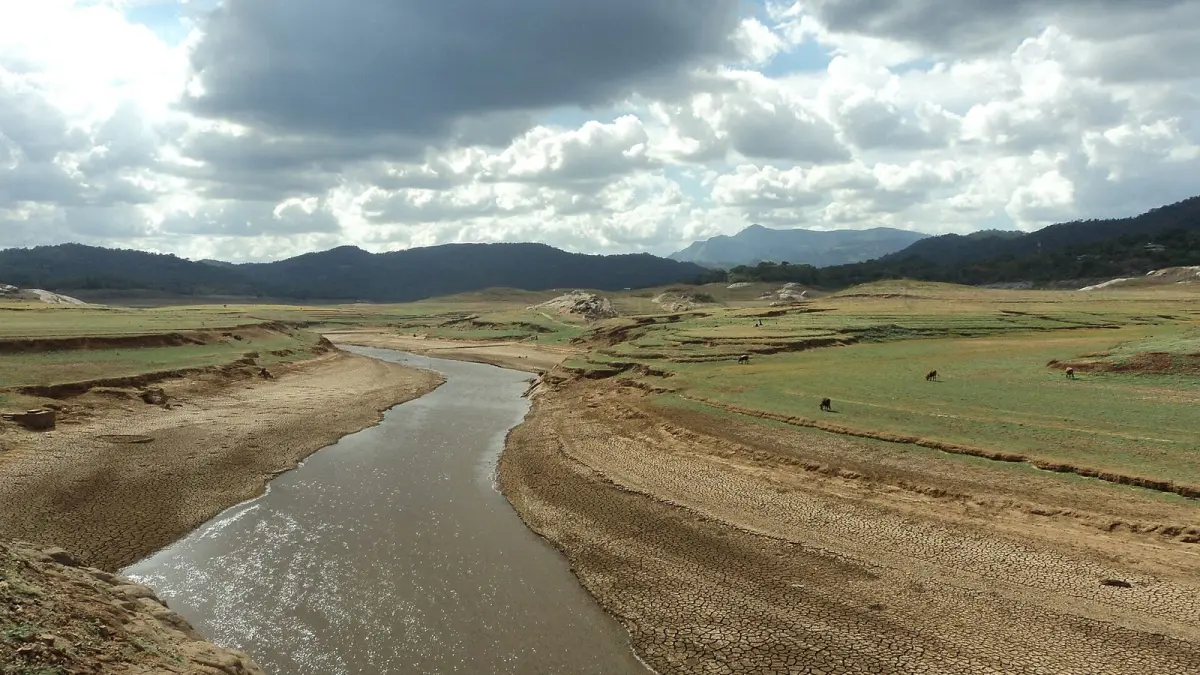
The drought that began in March 2023 did not end until the very wet spring of 2025. Low reservoirs have become a familiar image: the Dolmen of Guadalperal, a prehistoric stone monument nicknamed the "Spanish Stonehenge", was flooded by the Valdecañas reservoir in Extremadura in 1963 and reappeared when the water dropped during the droughts of 2019 and 2022.
Wildfires are the other side of the same coin. In August 2025, the European Forest Fire Information System (EFFIS) estimated that more than 380,000 hectares (940,000 acres) had burned in Spain that year, the worst season since 1994. The IPCC lists the Mediterranean as one of the regions most exposed to increasing drought this century.
At the same time, warmer air can hold about 7% more water vapor for each degree Celsius, which favors heavier downpours when a storm system such as a DANA stalls over the coast.
Is Spain hot all year round?
No, Spain is not hot all year round: inland winters are cold, and only the Canary Islands stay mild in every month. Madrid, on a plateau about 650 m (2,100 ft) high, has winter nights close to freezing, and cities such as Burgos get frequent frost and occasional snow.
The Mediterranean coast, from Barcelona to Malaga, has mild winters with cool nights, while the Canary Islands, at the latitude of the Sahara, are spring-like in January. If you plan a winter trip, check the 7 day forecast for Malaga or the weather in Santa Cruz de Tenerife.
Why is the sun hotter in Spain than in England?
The sun feels hotter in Spain than in England because Spain is much farther south, so the sun climbs higher in the sky and its rays reach the ground more directly. At the June solstice, the noon sun stands about 73° above the horizon in Madrid (40° N) but only about 62° in London (51° N). The same sunlight is concentrated on a smaller area, and the UV index is higher; our guide to the UV index explains what each level means for your skin.
What does climate change mean for your daily weather in Spain?
For daily weather, climate change mostly means more days of intense heat and fewer cold days, not that every day is different. Spain will still have cold winters, snow and cold snaps, but they are becoming somewhat less frequent.
- More frequent and longer heat waves, starting earlier, sometimes in June or even May.
- More heat records than cold ones: in 2025, AEMET's main network set 25 daily heat records and no cold ones. We review the all-time values in the hottest and coldest temperatures on record.
- Warmer nights in cities and on the coast.
- Less snow in mid-altitude mountains and more irregular ski seasons.
- Sharper contrast between dry spells and heavy rain.
How to use Clima de Hoy to adapt to the heat
Adapting starts with checking the forecast ahead and planning the day around the hottest hours. Look at the hourly forecast for Madrid to see when the temperature drops in the evening, or the 14 day forecast for Seville to see whether a heat wave is coming.
A few useful habits: exercise and run errands early, air your home at night if it is cooler outside than inside, and keep an eye on older people during heat waves. If someone shows signs of heat stroke, call 112, the emergency number in Spain and the rest of the EU.
Frequently asked questions
How much has Spain's temperature risen?
According to AEMET's 2025 state of the climate report, Spain's average yearly temperature has risen by 1.75 °C (3.2 °F) since 1961. The year 2025 averaged 15.1 °C (59.2 °F), 1.1 °C above the 1991-2020 average. Summer 2026 was the hottest in the official series.
What are the effects of climate change in Spain?
The main effects are more and longer heat waves, summers about five weeks longer than in the 1980s, more tropical nights and a warmer Mediterranean. Evaporation, drought risk and wildfire risk are also increasing, along with episodes of intense rain. Snow in mid-altitude mountains is declining.
Is Spain getting less rain because of climate change?
Across Spain as a whole, there is no significant trend in total yearly rainfall since 1961, according to AEMET. However, heat increases evaporation, so the same rain goes less far, and long droughts alternate with torrential rain. IPCC projections point to more drought in the Mediterranean.
Does a cold winter mean there is no climate change?
No. A cold winter is weather, and climate change is measured with averages over at least 30 years. Cold snaps and snowfalls still happen in a warming climate, although less often. The trend shows in heat records outnumbering cold records year after year.
Weather in your city
- Weather in Ciudad de México
- Weather in Londres
- Weather in Nueva York
- Weather in Bogotá
- Weather in Madrid
- Weather in Buenos Aires
- Weather in París
- Weather in Barcelona
- Weather in Valencia
- Weather in Sevilla
- Weather in Málaga
- Weather in Bilbao